
Last updated: 24 November 2026

Boats use either a built-in marine toilet, manual or electric, with hoses and a holding tank, or a portable toilet such as a chemical toilet or a separating toilet. The toilet on board plays a big part in how relaxed your sailing trip turns out to be. A leaking or complicated marine toilet quickly causes stress on board, and few things are more unpleasant than a blocked toilet out on the water. This article explains the different types of boat toilets, where their weaknesses lie, and why a separating toilet is a practical alternative, especially on smaller boats.
Key points at a glance
- Permanently installed marine toilets are available as manual pump toilets or electric toilets. Both require water, hoses, and a holding tank.
- Typical problems include blockages, leaking valves, and overflowing when heeling or in rough seas.
- On small boats with no space for tanks, portable toilets are an option, either chemical toilets or separating toilets.
- A separating toilet requires no water and no chemicals, and has no hoses that can get blocked.
- You dispose of urine on land in a regular toilet, and solids in a sealed bag with your household waste.
Boat toilets compared
| Manual marine toilet | Electric marine toilet | Chemical toilet | Separating toilet | |
|---|---|---|---|---|
| Water | required | required | required | not required |
| Electricity | not required | required | not required | not required |
| Chemicals | none | none | sanitary fluid | none |
| Installation | permanent, with tank and hoses | permanent, with tank and hoses | portable | portable |
| Disposal | pump-out station in the harbour | pump-out station in the harbour | disposal point | urine in any toilet, solids in household waste |
| Typical problems | blockages, overflowing | blockages, loud pumping | sloshing, chemical odour | you need to bring litter and bags |
Permanently installed marine toilets
Many boats and yachts have a manual or electric marine toilet installed. Both need a briefing before you set sail, because they are far from easy to use without one.
Manual marine toilet
Next to the bowl, there is a switch for flushing, one for pumping out, and a pump lever. To pump out, you flip the switch and pump with the lever. Then you switch to flush and pump around 20 times so that the water washes everything through. Finally, you pump the bowl dry once more and lock the lever.
Advantages:
- works without electricity
- quieter than an electric marine toilet
- spare parts are usually easy to find
Disadvantages:
- operation requires instruction
- lots of pumping
- water consumption is hard to monitor, so the holding tank fills up and the fresh water tank empties quickly
- blocks easily, a spare parts kit should always be kept on board
BOXIO TOILET | Separating toilet in Eurobox format
Electric marine toilet
An electric marine toilet works similarly to a manual one, but a motor pumps instead of your hand. Instead of a pump lever, there are two switches for flushing and pumping out.
Advantages:
- no pumping by hand
- controlled water consumption per flush
Disadvantages:
- high power consumption
- the pump is loud, especially at night
- more expensive to purchase
- you should also keep a spare parts kit on board
Tips for flushing and toilet paper
To prevent unpleasant odours, it helps to flush with fresh water rather than sea water. To keep hoses and pumps from blocking, some crews throw toilet paper into a bin next to the toilet. However, this is less hygienic and can smell. Marine toilets with a macerator help, but they cannot handle everything either.
Disposal for permanently installed marine toilets
The waste water collects in a holding tank. When and where ship sewage may be discharged into the sea is regulated internationally by the MARPOL convention. The maritime authority of the country where you sail can tell you the local rules. A general MARPOL overview in German is available here: MARPOL overview. Near the coast and on inland waterways, you empty the tank at a pump-out station in the harbour.
Risk of overflowing below the waterline
Marine toilets that flush with sea or river water require through-hull fittings below the waterline. The siphon effect can cause the toilet to overflow. A vented loop reduces the risk, but does not eliminate it entirely. When heeling, in heavy swell, and during pumping, the risk remains.
Portable boat toilets for small boats

On small motorboats, sailing boats, or cabin cruisers, there is often no room for water tanks, holding tanks, and pipework. This is where portable toilets are the better choice.

Chemical toilet
A chemical toilet has its own small tank with sanitary fluid that breaks down waste and toilet paper. This mixture must not go into the water; empty it only at the disposal point in the harbour. Because there is liquid in the tank, it can slosh around in choppy waters, and you come into contact with chemicals during cleaning.
Separating toilet
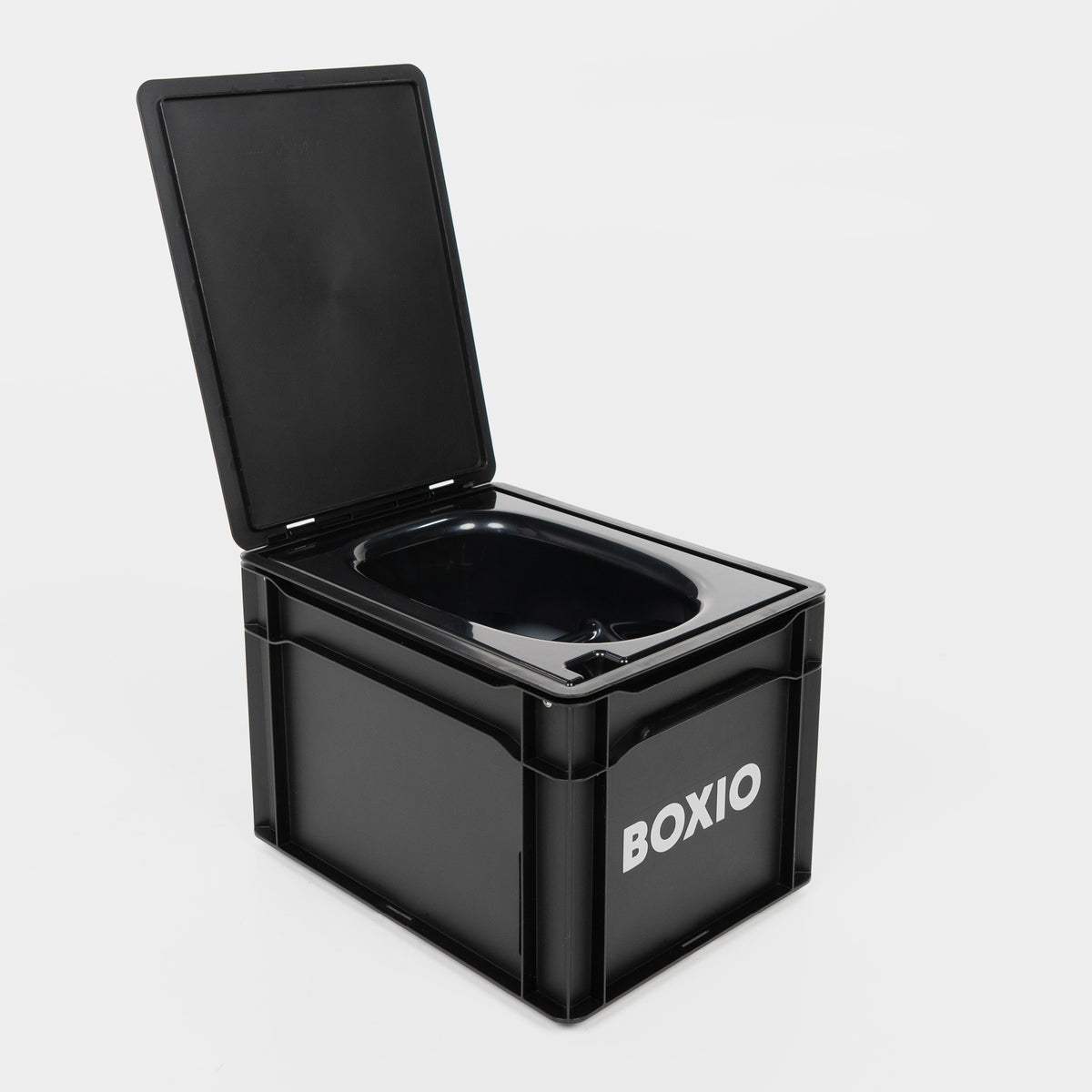
A separating toilet separates liquids and solids and works without water and without chemicals. It is also called a composting toilet, because the separation makes composting possible. It is compact and portable, which makes it suitable for small boats, cabin cruisers and sailing boats.
BOXIO TOILET | Separating toilet in Eurobox format
How the separating toilet works
Under the seat, a urine diverter directs urine into a sealable container. Solids fall into a separate container lined with a compostable bag. Because urine and solids do not mix, significantly fewer odours develop. A little hemp litter after each use binds moisture as well.
How to dispose of waste properly on board
Empty the urine container on land into a standard toilet, for example at the harbour or on a campsite. Tie the bag with the solids closed and put it in the household waste. Observe local regulations. None of this belongs in the water.
The BOXIO TOILET on board
The BOXIO TOILET is a separating toilet in Eurobox format measuring 40 × 30 × 28 cm and weighing 2.81 kg. It has a 5.7 L solids container, fits under a bench seat or into a storage locker and holds enough for about 8 to 10 uses. With the new Eurobox, you can see the fill level of the urine container from the outside, and the hinged lid stays open on its own when you lift it.
For longer trips or more people on board, there is the TOILET XL, which has an 8 L solids container and a 7 L urine container and holds enough for about 11 to 14 uses. You can equip the urine container with the SMELL GUARD, a magnetic odour trap that opens during use and closes automatically afterwards.
Tip while underway: Secure the box against slipping, for example with an anti-slip mat or a lashing strap. You can connect several Euroboxes with the CLIP 2.0 so that nothing tips over in rough seas. To wash your hands on board, the BOXIO WASH is a portable camping sink with a 5 L fresh water container and a 5 L grey water container in the same Eurobox format.
Advantages and disadvantages of the separating toilet
- Compact and portable, fits on small boats as well
- No water, no chemicals, no electricity
- No hoses, valves or pumps that can clog or leak
- Significantly fewer odours thanks to separation
- Easy disposal with bags
- Disadvantage: you need to bring litter and bags on board
No more clogged marine toilets and overflowing tanks


With built-in marine toilets, often only the skipper knows how everything works, and waste can still slosh over or cause odours. A separating toilet avoids these problems because it has no tank, hoses or pumps. You do not need a waste pump, a pump-out station or repairs below deck. You will not wake anyone up at night, and there are no maintenance costs for pumps and valves.
Especially on smaller boats, a separating toilet can be installed in a fixed spot, for example behind wooden panelling in a nautical style.
FAQ: boat toilets
Which toilet is best for a boat or yacht?
Large yachts with a holding tank usually have a built-in marine toilet. On a small yacht or boat without a holding tank, a portable toilet is easier to use. For these boats, a separating toilet is the simplest solution because it works without water, chemicals or hoses.
How does a separating toilet work on a boat?
A urine diverter directs urine into a container, while solids drop into a separate container with a bag and litter. You do not need water or chemicals.
Where do I dispose of the contents of a boat toilet?
You empty a holding tank at a pump-out station at the harbour. With a separating toilet, you pour the urine into a standard toilet on land and place the sealed bag containing the solids into the household waste.
How often do I need to empty a separating toilet on board?
The BOXIO TOILET holds enough for about 8 to 10 uses, the TOILET XL for about 11 to 14. You change the bag roughly every 2 to 3 days.